
Home Office Clarifies Rules on Varying Human Rights Applications
LONDON, Aug. 29, 2026 – The Home Office has updated its official guidance to confirm that human rights applications can be varied, resolving a long-standing inconsistency between published guidance and the Immigration Rules. Paragraph 34BB of the Immigration Rules has consistently provided that any immigration application, including one involving a human rights claim, may be […]
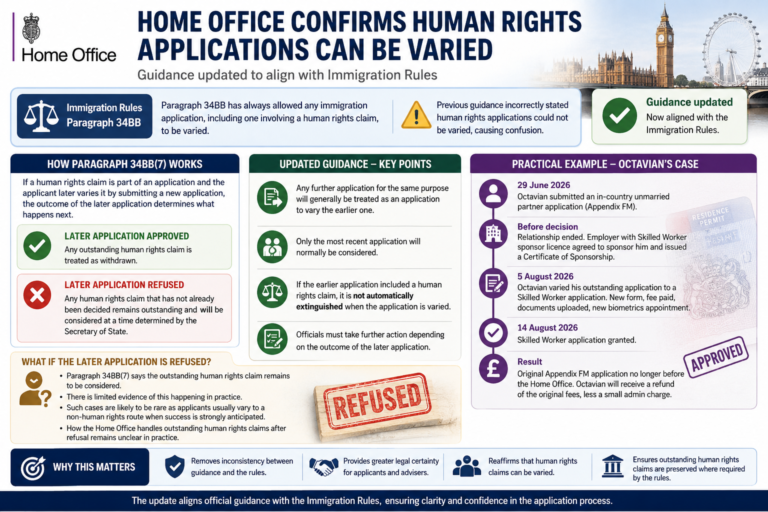
LONDON, Aug. 29, 2026 – The Home Office has updated its official guidance to confirm that human rights applications can be varied, resolving a long-standing inconsistency between published guidance and the Immigration Rules.
Paragraph 34BB of the Immigration Rules has consistently provided that any immigration application, including one involving a human rights claim, may be varied. However, until recently, the Home Office’s guidance titled “Validation, variation, voiding and withdrawal of applications” stated that human rights applications could not be varied, creating uncertainty among immigration practitioners and applicants.
The discrepancy centred on paragraph 34BB(7), which outlines the treatment of a human rights claim when an applicant submits a subsequent application that varies an earlier one. Under the rule, if a person makes a human rights claim as part of an application and later varies that application by submitting a new one, the outcome of the later application determines what happens next.
If the subsequent application is approved, any outstanding human rights claim is treated as withdrawn. If the later application is refused, any human rights claim that has not already been decided remains outstanding and is to be considered at a time determined by the Secretary of State.
The wording of the rule has long indicated that human rights applications can, in fact, be varied. Immigration practitioners have argued that the previous guidance appeared to stem from a misunderstanding of the provision, particularly given that the rule explicitly describes circumstances in which a human rights application is varied and sets out the consequences of both approval and refusal.
The Home Office has now amended its guidance to bring it into line with the Immigration Rules. The revised guidance states that where an applicant has an undecided application for entry clearance or permission to stay, any further application for the same purpose will generally be treated as an application to vary the earlier one, with only the most recent application being considered.
The updated guidance further explains that where the earlier application included a human rights claim, that claim is not automatically extinguished when the application is varied. Instead, officials must take further action depending on the outcome of the later application. If the later application succeeds, the outstanding human rights claim will be treated as withdrawn. If it fails, any undecided human rights claim remains outstanding and will be considered at a later stage determined by the Secretary of State.
According to the account accompanying the guidance change, the amendment reportedly required intervention from Home Office legal advisers. The clarification has been described as unusual given that, in practice, the Home Office had already been permitting applicants to vary human rights applications despite the contradictory wording in its guidance.
The revision is not expected to alter day-to-day decision-making but is viewed as an important step in providing greater legal certainty and ensuring that official guidance accurately reflects the rules governing immigration applications.
A practical example illustrates how the process operates. An applicant named Octavian submitted an in-country unmarried partner application under Appendix FM on June 29, 2026. Before a decision was made, the relationship on which the application was based ended. Octavian’s employer, which held a Skilled Worker sponsor licence, subsequently agreed to sponsor him and issued a Certificate of Sponsorship.
Using that certificate, Octavian varied his outstanding Appendix FM application to a Skilled Worker application on Aug. 5, 2026. He submitted a new application form, paid the relevant fee, uploaded the required documents and attended a fresh biometrics appointment. The Skilled Worker application was then granted on Aug. 14, 2026.
In such circumstances, the original Appendix FM application is no longer before the Home Office for consideration because it has been replaced by the later application. As a result, Octavian would eventually receive a refund of the original application fees, less a small administrative charge.
The position becomes less clear when a varied application is refused. Although paragraph 34BB(7) expressly states that an outstanding human rights claim from the original application remains to be considered if the subsequent application is rejected, there appears to be limited evidence of this occurring in practice.
Observers note that such situations are likely to be rare. Applicants generally move from a human rights-based route to a non-human rights route, such as a work or study application, only when they have strong grounds to believe the latter application will succeed. As a result, refusals following such variations are relatively uncommon.
Questions also remain about how the Home Office handles outstanding human rights claims after refusing a varied non-human rights application. While the Immigration Rules provide for those claims to remain alive and subject to future consideration, examples of this process being carried out in practice appear difficult to identify.
The updated guidance nevertheless represents a significant clarification for applicants and immigration advisers. By aligning official guidance with the Immigration Rules, the Home Office has removed a source of confusion and reaffirmed that human rights applications can be varied, while preserving the continued consideration of any outstanding human rights claim where required under the rules.